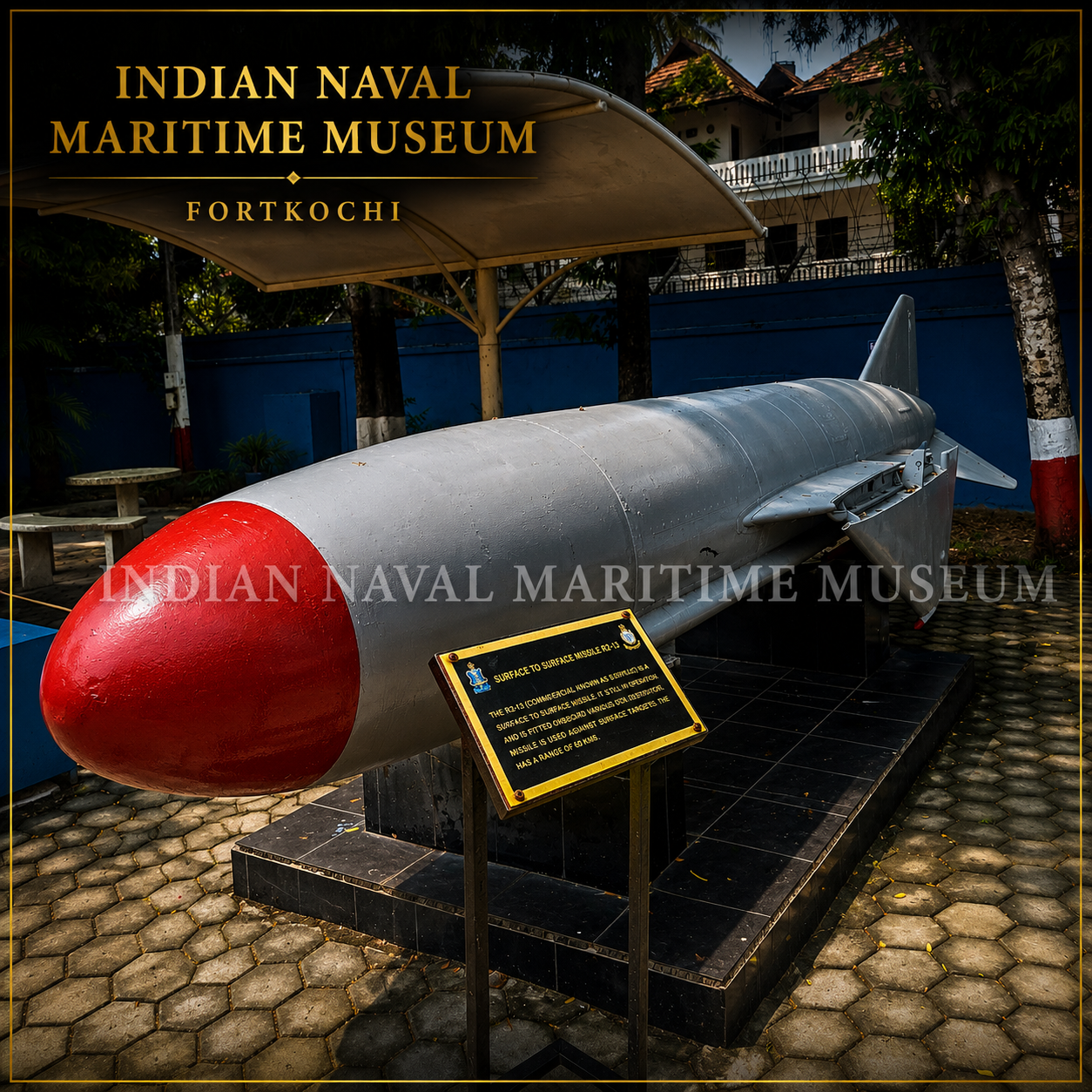
P-21 Surface-to-Surface Missile
Audio Guide
Listen to artifact story
Audio guide ready
The exhibit shown at the Indian Naval Maritime Museum is the P-21 Surface-to-Surface Missile, a Soviet-designed anti-ship cruise missile developed to destroy enemy warships at sea. It was one of the most important naval strike weapons of its era and served with several navies, including the Indian Navy.
The P-21 was designed to be launched from missile boats and warships. After launch, it would fly at high subsonic speed towards its target and use radar guidance to locate and strike enemy vessels. The missile carried a large high-explosive warhead capable of causing severe damage to warships.
Technical Specifications
Name: P-21 Surface-to-Surface Missile
Type: Anti-Ship Cruise Missile
Origin: Soviet Union
Length: Approximately 7.5 metres
Weight: Around 2.5 tonnes
Speed: About Mach 0.9 (near the speed of sound)
Range: Approximately 80 km
Guidance: Active Radar Homing
Warhead: High-Explosive
Launch Platform: Missile Boats and Warships
Role and Importance
Designed to destroy enemy surface vessels.
Provided long-range strike capability to naval forces.
Allowed warships to attack targets beyond visual range.
Played a major role in naval warfare during the Cold War era.
Enhanced fleet offensive power and sea-control operations.
Historical Significance
The P-21 missile belongs to the family of Soviet anti-ship missiles that revolutionized naval warfare. Similar missiles were used extensively around the world and demonstrated how guided missile technology could threaten even large warships from long distances.
The Indian Navy's missile boats armed with Soviet anti-ship missiles achieved historic success during the 1971 Indo-Pak War, proving the effectiveness of missile-based naval warfare.
Interesting Fact
Unlike a torpedo that travels underwater, the P-21 travels above the sea surface at very high speed and uses onboard radar to find its target. Once locked onto a ship, it can strike with tremendous force, making it one of the most feared anti-ship weapons of its time.
Museum Note
The P-21 Surface-to-Surface Missile displayed at the Indian Naval Maritime Museum, Fort Kochi, represents a major milestone in naval missile technology and highlights the transition from traditional naval guns to modern guided missile warfare.
The P-21 was designed to be launched from missile boats and warships. After launch, it would fly at high subsonic speed towards its target and use radar guidance to locate and strike enemy vessels. The missile carried a large high-explosive warhead capable of causing severe damage to warships.
Technical Specifications
Name: P-21 Surface-to-Surface Missile
Type: Anti-Ship Cruise Missile
Origin: Soviet Union
Length: Approximately 7.5 metres
Weight: Around 2.5 tonnes
Speed: About Mach 0.9 (near the speed of sound)
Range: Approximately 80 km
Guidance: Active Radar Homing
Warhead: High-Explosive
Launch Platform: Missile Boats and Warships
Role and Importance
Designed to destroy enemy surface vessels.
Provided long-range strike capability to naval forces.
Allowed warships to attack targets beyond visual range.
Played a major role in naval warfare during the Cold War era.
Enhanced fleet offensive power and sea-control operations.
Historical Significance
The P-21 missile belongs to the family of Soviet anti-ship missiles that revolutionized naval warfare. Similar missiles were used extensively around the world and demonstrated how guided missile technology could threaten even large warships from long distances.
The Indian Navy's missile boats armed with Soviet anti-ship missiles achieved historic success during the 1971 Indo-Pak War, proving the effectiveness of missile-based naval warfare.
Interesting Fact
Unlike a torpedo that travels underwater, the P-21 travels above the sea surface at very high speed and uses onboard radar to find its target. Once locked onto a ship, it can strike with tremendous force, making it one of the most feared anti-ship weapons of its time.
Museum Note
The P-21 Surface-to-Surface Missile displayed at the Indian Naval Maritime Museum, Fort Kochi, represents a major milestone in naval missile technology and highlights the transition from traditional naval guns to modern guided missile warfare.