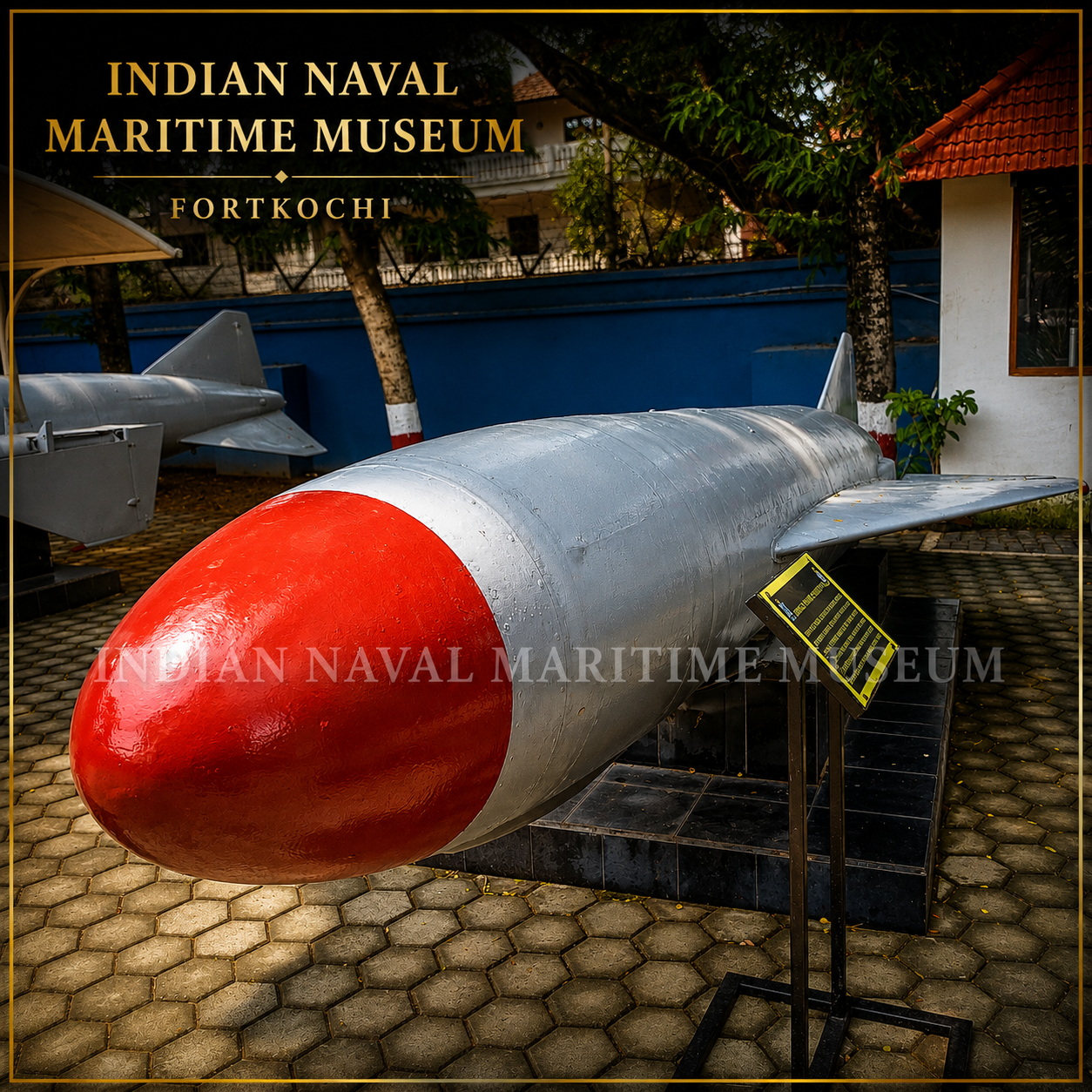
P-15 Termit (SS-N-2 Styx) Anti-Ship Missile
Audio Guide
Listen to artifact story
Audio guide ready
The P-15 Termit, known by NATO as SS-N-2 Styx, was one of the world's first successful anti-ship guided missiles. Developed by the Soviet Union in the 1950s, it revolutionized naval warfare by enabling relatively small warships to destroy much larger enemy vessels from long distances.
The missile was designed to attack enemy surface ships using an onboard radar guidance system. After launch, it flew towards the target at high subsonic speed and delivered a powerful high-explosive warhead capable of causing catastrophic damage.
Technical Specifications
Name: P-15 Termit (SS-N-2 Styx)
Type: Surface-to-Surface Anti-Ship Missile
Origin: Soviet Union
Length: 6.5 metres
Weight: Approximately 2,300 kg
Speed: Around Mach 0.9
Range: 40–80 km (depending on variant)
Guidance: Active Radar Homing
Warhead: About 500 kg High-Explosive
Launch Platform: Missile Boats, Warships, Coastal Batteries
Role and Importance
Designed to destroy enemy warships.
Allowed small missile boats to engage larger naval vessels.
One of the earliest operational anti-ship guided missiles.
Changed naval tactics around the world.
Became a symbol of missile warfare at sea.
Indian Navy Connection
The P-15 missile became famous in India during the 1971 Indo-Pak War. Indian Navy missile boats armed with P-15 missiles carried out Operation Trident and Operation Python, attacking Karachi Harbour and sinking or damaging several Pakistani naval and merchant vessels.
These attacks are considered among the most successful naval missile strikes in history and established the Indian Navy as a formidable maritime force.
Historical Significance
The P-15 was the missile that proved guided missiles could dominate naval combat. Its success led navies worldwide to invest heavily in missile-equipped warships and modern anti-ship weapons.
Interesting Fact
On 4 December 1971, Indian Navy missile boats armed with P-15 missiles struck Karachi Harbour in a daring night attack. The success of this operation is one reason why 4 December is celebrated as Indian Navy Day every year.
Museum Note
If the exhibit is a P-15 missile, it represents one of the most influential naval weapons of the Cold War and a weapon that played a significant role in India's naval history during the 1971 war.
The missile was designed to attack enemy surface ships using an onboard radar guidance system. After launch, it flew towards the target at high subsonic speed and delivered a powerful high-explosive warhead capable of causing catastrophic damage.
Technical Specifications
Name: P-15 Termit (SS-N-2 Styx)
Type: Surface-to-Surface Anti-Ship Missile
Origin: Soviet Union
Length: 6.5 metres
Weight: Approximately 2,300 kg
Speed: Around Mach 0.9
Range: 40–80 km (depending on variant)
Guidance: Active Radar Homing
Warhead: About 500 kg High-Explosive
Launch Platform: Missile Boats, Warships, Coastal Batteries
Role and Importance
Designed to destroy enemy warships.
Allowed small missile boats to engage larger naval vessels.
One of the earliest operational anti-ship guided missiles.
Changed naval tactics around the world.
Became a symbol of missile warfare at sea.
Indian Navy Connection
The P-15 missile became famous in India during the 1971 Indo-Pak War. Indian Navy missile boats armed with P-15 missiles carried out Operation Trident and Operation Python, attacking Karachi Harbour and sinking or damaging several Pakistani naval and merchant vessels.
These attacks are considered among the most successful naval missile strikes in history and established the Indian Navy as a formidable maritime force.
Historical Significance
The P-15 was the missile that proved guided missiles could dominate naval combat. Its success led navies worldwide to invest heavily in missile-equipped warships and modern anti-ship weapons.
Interesting Fact
On 4 December 1971, Indian Navy missile boats armed with P-15 missiles struck Karachi Harbour in a daring night attack. The success of this operation is one reason why 4 December is celebrated as Indian Navy Day every year.
Museum Note
If the exhibit is a P-15 missile, it represents one of the most influential naval weapons of the Cold War and a weapon that played a significant role in India's naval history during the 1971 war.