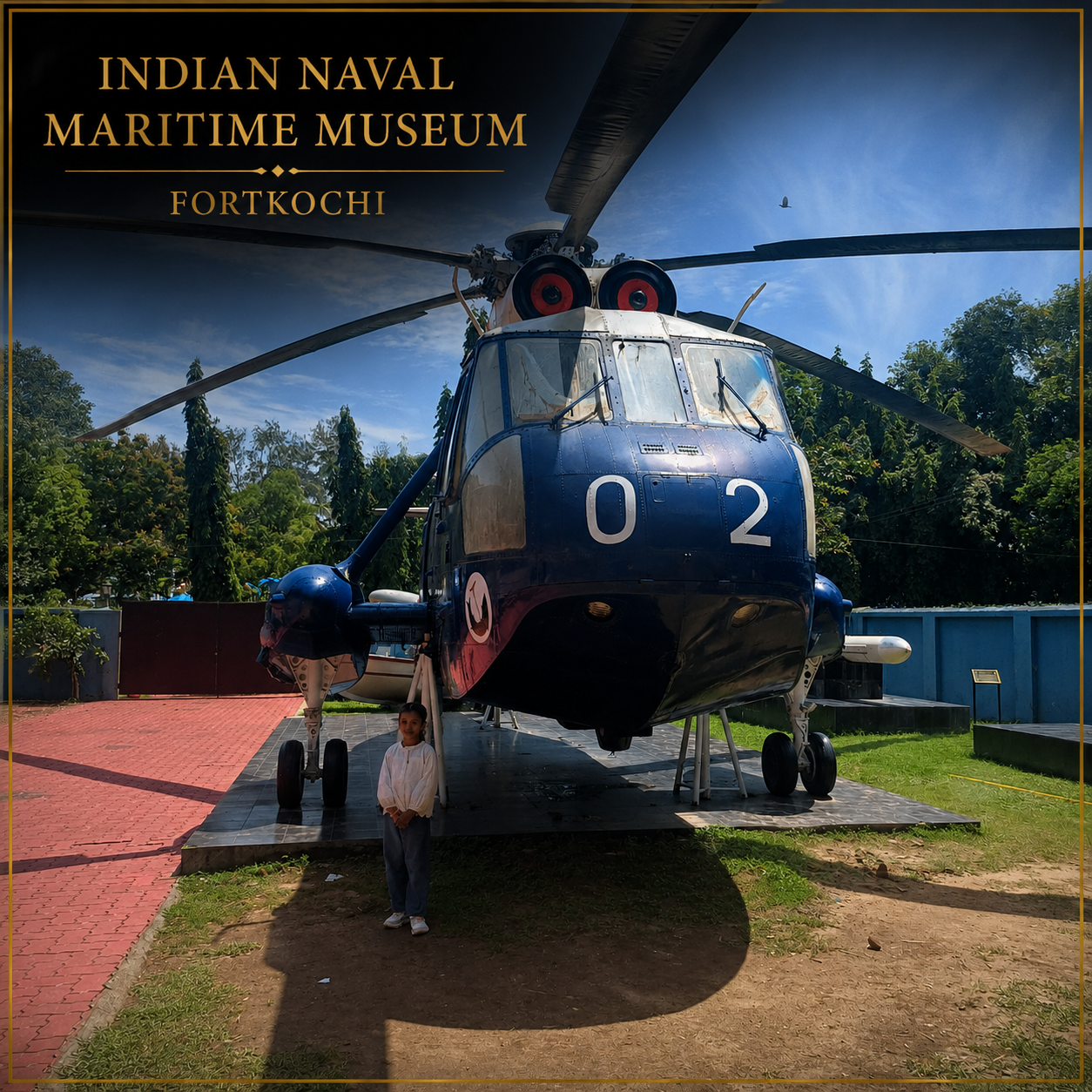
Sea King Helicopter
Audio Guide
Listen to artifact story
Audio guide ready
The Sea King is a multi-role naval helicopter that served as one of the most important helicopters in the Indian Navy for several decades. Introduced into Indian naval service in the 1970s, it was primarily used for anti-submarine warfare, anti-ship missions, search and rescue operations, maritime surveillance, troop transport, and logistical support.
Powered by twin turbine engines, the Sea King was designed to operate from aircraft carriers, destroyers, and frigates. Its advanced radar and sonar systems enabled it to detect enemy submarines and surface vessels over long distances, making it a vital component of India's maritime defense capabilities.
The Indian Navy operated several variants, including the Sea King Mk 42, which became famous for its reliability and versatility. During its service, the helicopter participated in numerous naval exercises, rescue missions, humanitarian operations, and coastal security patrols.
After decades of distinguished service, many Sea King helicopters were retired and preserved in museums as symbols of India's naval aviation heritage. The helicopter displayed at the Indian Naval Maritime Museum, Fort Kochi, stands as a tribute to the pilots, aircrew, and maintenance personnel who operated and supported this legendary aircraft.
Key Facts
Name: Sea King
Manufacturer: Westland Helicopters
Role: Multi-role Naval Helicopter
Indian Navy Variant: Sea King Mk 42
Crew: Typically 2–4 personnel
Primary Missions:
Anti-Submarine Warfare (ASW)
Anti-Ship Warfare (AShW)
Search and Rescue (SAR)
Maritime Surveillance
Troop and Cargo Transport
Entered Indian Navy Service: 1970s
Interesting Fact: The Sea King was often called the "workhorse of the Indian Navy" because it could perform many different missions from a single platform, making it one of the most versatile helicopters ever operated by the Navy.
Powered by twin turbine engines, the Sea King was designed to operate from aircraft carriers, destroyers, and frigates. Its advanced radar and sonar systems enabled it to detect enemy submarines and surface vessels over long distances, making it a vital component of India's maritime defense capabilities.
The Indian Navy operated several variants, including the Sea King Mk 42, which became famous for its reliability and versatility. During its service, the helicopter participated in numerous naval exercises, rescue missions, humanitarian operations, and coastal security patrols.
After decades of distinguished service, many Sea King helicopters were retired and preserved in museums as symbols of India's naval aviation heritage. The helicopter displayed at the Indian Naval Maritime Museum, Fort Kochi, stands as a tribute to the pilots, aircrew, and maintenance personnel who operated and supported this legendary aircraft.
Key Facts
Name: Sea King
Manufacturer: Westland Helicopters
Role: Multi-role Naval Helicopter
Indian Navy Variant: Sea King Mk 42
Crew: Typically 2–4 personnel
Primary Missions:
Anti-Submarine Warfare (ASW)
Anti-Ship Warfare (AShW)
Search and Rescue (SAR)
Maritime Surveillance
Troop and Cargo Transport
Entered Indian Navy Service: 1970s
Interesting Fact: The Sea King was often called the "workhorse of the Indian Navy" because it could perform many different missions from a single platform, making it one of the most versatile helicopters ever operated by the Navy.