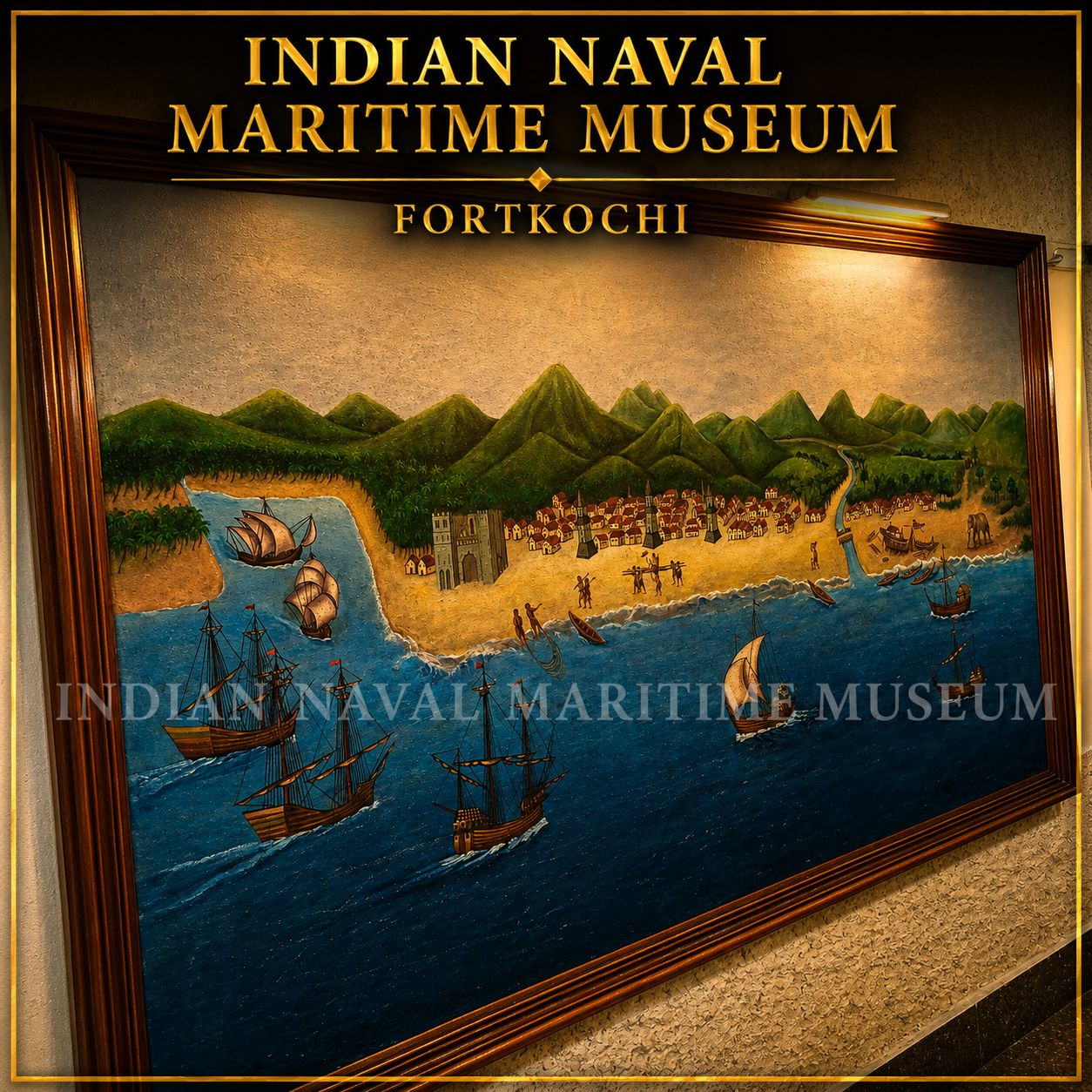
Port of Calicut as Viewed by Portuguese Merchant Ships (16th Century)
Audio Guide
Listen to artifact story
Audio guide ready
This artwork is an artistic reconstruction depicting the Port of Calicut (Kozhikode) as it may have appeared to Portuguese merchant ships during the late 15th and early 16th centuries. It illustrates the historic moment when European vessels first approached the prosperous Malabar Coast, drawn by the region's world-famous spice trade.
The painting portrays a thriving coastal settlement surrounded by lush green hills, busy marketplaces, traditional fishing boats, and Portuguese sailing ships anchored offshore. It captures the vibrant maritime environment that made Calicut one of the most important international trading ports in the Indian Ocean.
On 11 May 1498, the Portuguese explorer Vasco da Gama reached the Malabar Coast near Kappad and established contact with the Zamorin of Calicut. This historic voyage opened the first direct sea route between Europe and India, transforming global trade and marking the beginning of European maritime influence in the Indian Ocean.
Rather than being an exact historical record, this painting is an interpretative visual representation based on historical accounts. It helps visitors imagine how Portuguese sailors would have viewed the bustling Port of Calicut during the Age of Discovery, highlighting the city's significance as a global centre of commerce and maritime heritage.
Today, the artwork serves as a tribute to Kerala's rich maritime legacy and the pivotal role that the Port of Calicut played in connecting cultures, civilizations, and trade routes across the world.
The painting portrays a thriving coastal settlement surrounded by lush green hills, busy marketplaces, traditional fishing boats, and Portuguese sailing ships anchored offshore. It captures the vibrant maritime environment that made Calicut one of the most important international trading ports in the Indian Ocean.
On 11 May 1498, the Portuguese explorer Vasco da Gama reached the Malabar Coast near Kappad and established contact with the Zamorin of Calicut. This historic voyage opened the first direct sea route between Europe and India, transforming global trade and marking the beginning of European maritime influence in the Indian Ocean.
Rather than being an exact historical record, this painting is an interpretative visual representation based on historical accounts. It helps visitors imagine how Portuguese sailors would have viewed the bustling Port of Calicut during the Age of Discovery, highlighting the city's significance as a global centre of commerce and maritime heritage.
Today, the artwork serves as a tribute to Kerala's rich maritime legacy and the pivotal role that the Port of Calicut played in connecting cultures, civilizations, and trade routes across the world.