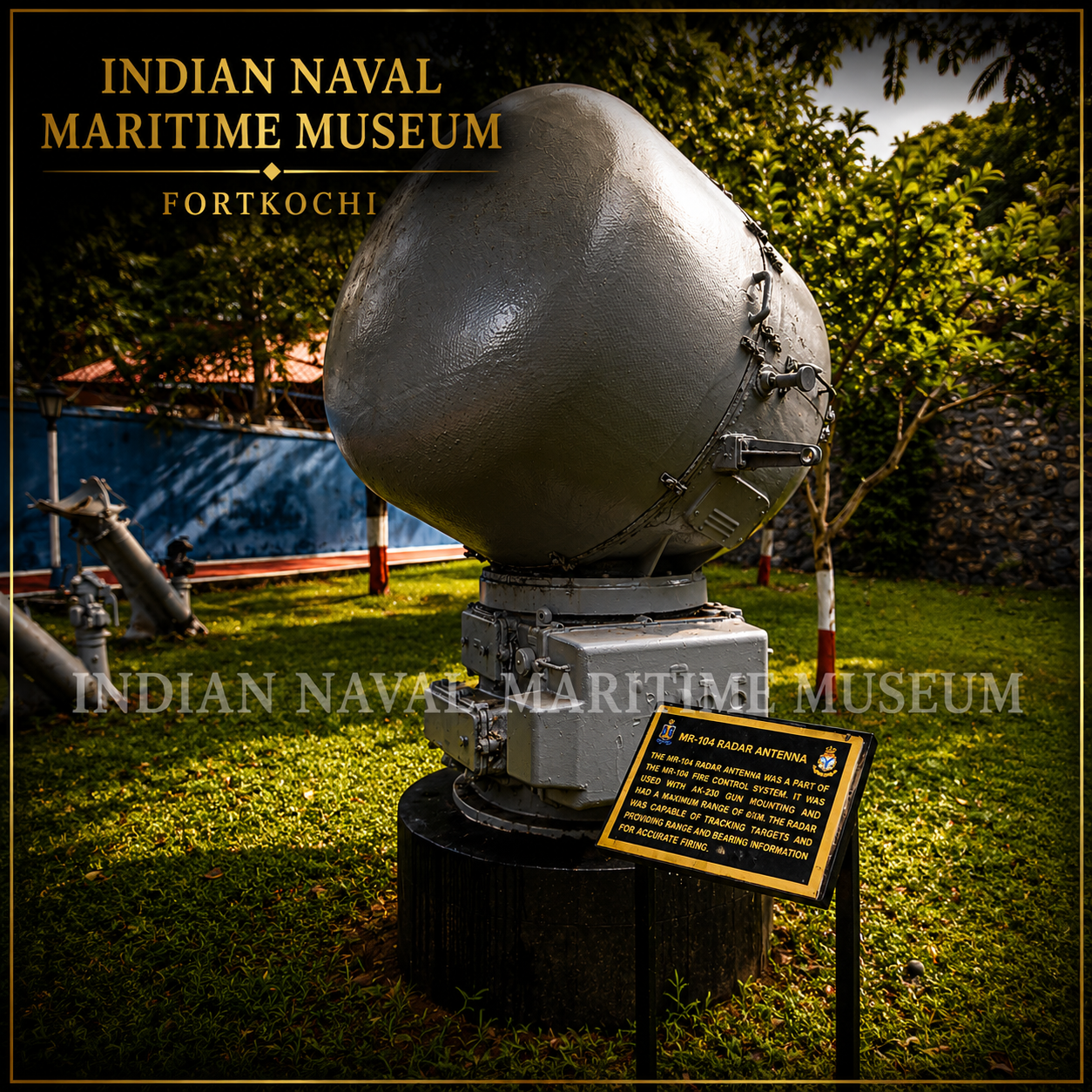
MR-104 Radar Antenna
Audio Guide
Listen to artifact story
Audio guide ready
The exhibit shown in the Indian Naval Maritime Museum is the MR-104 Radar Antenna, a naval fire-control radar used by warships to accurately track targets and guide naval guns during combat operations.
The MR-104 radar formed an important part of a ship's fire-control system, working alongside naval artillery to provide precise target information. By continuously tracking the position, distance, and movement of enemy targets, the radar helped improve the accuracy of gunfire against aircraft, ships, and other threats.
Mounted on naval vessels, the radar could operate in all weather conditions and during both day and night operations. It played a crucial role in enhancing a warship's defensive and offensive capabilities by supplying real-time targeting data to the gun control system.
Technical Information
Name: MR-104 Radar Antenna
Type: Naval Fire-Control Radar
Purpose: Target detection and gunfire control
Associated Weapon: AK-230 Naval Gun Mount
Maximum Range: Approximately 6 nautical miles (about 11 km)
Function: Tracks targets and provides range and bearing information for accurate firing
Importance
Improved accuracy of naval gun systems.
Enabled ships to engage fast-moving aerial and surface targets.
Operated effectively in poor visibility and adverse weather.
Increased the combat effectiveness of naval vessels.
Historical Significance
The MR-104 radar was widely used on Soviet-designed and Indian Navy warships during the Cold War era. It represented an important advancement in naval fire-control technology, allowing ships to react quickly and accurately to threats at sea.
Interesting Fact
Unlike search radars that scan large areas for targets, the MR-104 is a fire-control radar, meaning its primary role is to lock onto a specific target and continuously track it, providing precise aiming information to naval guns for accurate engagement.
The MR-104 radar formed an important part of a ship's fire-control system, working alongside naval artillery to provide precise target information. By continuously tracking the position, distance, and movement of enemy targets, the radar helped improve the accuracy of gunfire against aircraft, ships, and other threats.
Mounted on naval vessels, the radar could operate in all weather conditions and during both day and night operations. It played a crucial role in enhancing a warship's defensive and offensive capabilities by supplying real-time targeting data to the gun control system.
Technical Information
Name: MR-104 Radar Antenna
Type: Naval Fire-Control Radar
Purpose: Target detection and gunfire control
Associated Weapon: AK-230 Naval Gun Mount
Maximum Range: Approximately 6 nautical miles (about 11 km)
Function: Tracks targets and provides range and bearing information for accurate firing
Importance
Improved accuracy of naval gun systems.
Enabled ships to engage fast-moving aerial and surface targets.
Operated effectively in poor visibility and adverse weather.
Increased the combat effectiveness of naval vessels.
Historical Significance
The MR-104 radar was widely used on Soviet-designed and Indian Navy warships during the Cold War era. It represented an important advancement in naval fire-control technology, allowing ships to react quickly and accurately to threats at sea.
Interesting Fact
Unlike search radars that scan large areas for targets, the MR-104 is a fire-control radar, meaning its primary role is to lock onto a specific target and continuously track it, providing precise aiming information to naval guns for accurate engagement.