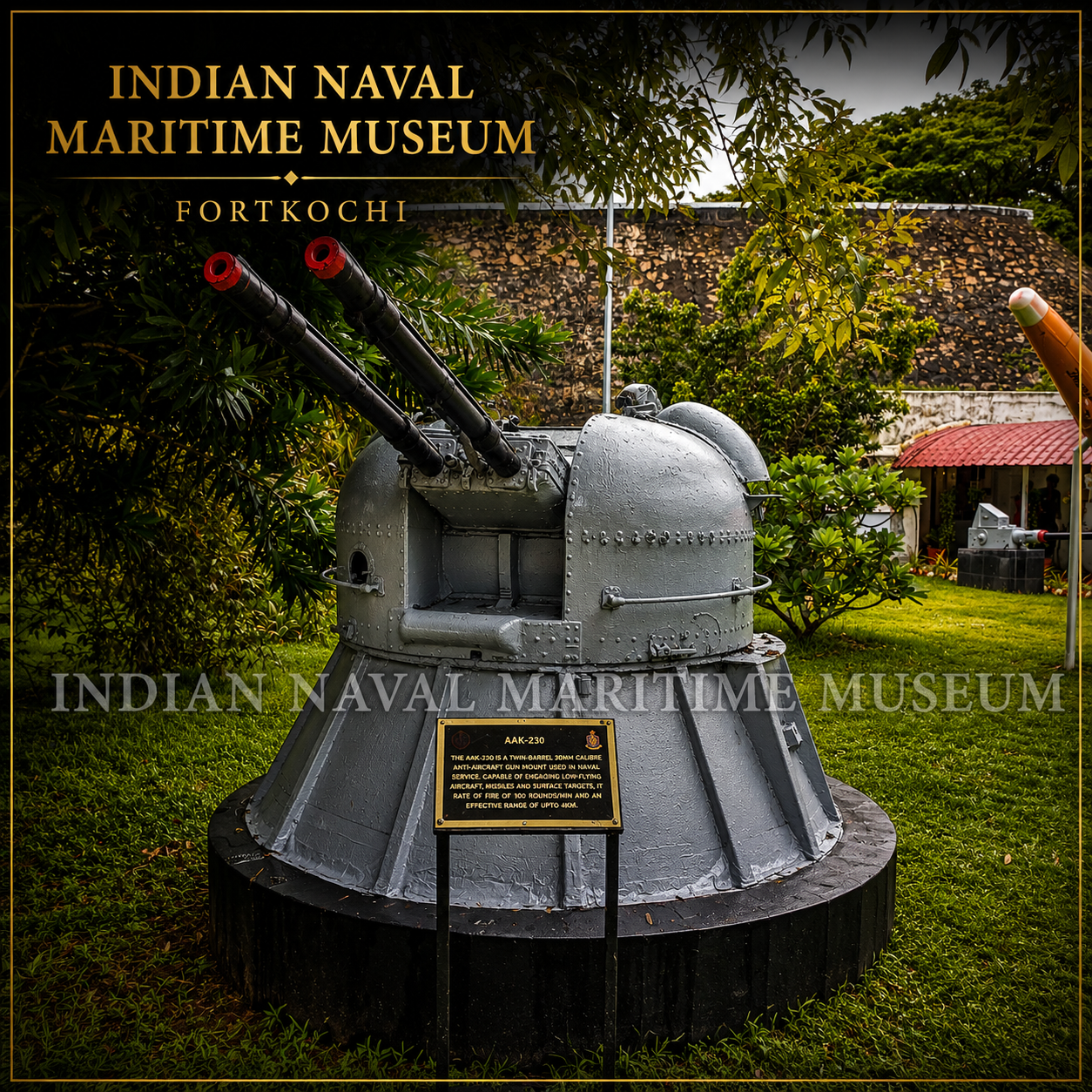
AK-230 Naval Gun Mount
Audio Guide
Listen to artifact story
Audio guide ready
AK-230 Naval Gun Mount – Detailed Summary
The exhibit in the Indian Naval Maritime Museum is the AK-230, a Soviet-designed twin-barrel naval gun system widely used by the Indian Navy for close-range air and surface defence.
The AK-230 was developed during the Cold War era as a rapid-fire weapon capable of engaging enemy aircraft, helicopters, missiles, and small surface vessels. Its high firing rate made it an effective last line of defence for warships against fast-moving threats.
The gun system is usually controlled by the MR-104 "Drum Tilt" fire-control radar, which automatically tracks targets and provides accurate aiming data. Together, the AK-230 and MR-104 formed an integrated weapon system on many naval vessels.
Technical Specifications
Name: AK-230 Naval Gun Mount
Type: Twin-Barrel Naval Anti-Aircraft Gun
Origin: Soviet Union
Calibre: 30 mm
Barrels: 2
Role: Close-in Air and Surface Defence
Maximum Firing Rate: Up to 1,000 rounds per minute
Effective Range: Approximately 4 km
Primary Targets:
Low-flying aircraft
Helicopters
Anti-ship missiles
Small boats and surface targets
Importance
Protected warships from aerial attacks.
Served as a close-range defence weapon.
Could engage fast-moving targets with high accuracy.
Operated in conjunction with naval radar systems.
Widely used on Indian Navy and other naval vessels for decades.
Historical Significance
The AK-230 became one of the first fully automatic naval gun systems adopted by many navies around the world. In the Indian Navy, it served on several warships and played an important role in fleet air defence during the latter half of the 20th century.
Interesting Fact
The AK-230 could fire hundreds of rounds within seconds, creating a dense wall of fire against incoming aircraft or missiles. Because of its rapid-fire capability, it was often considered a ship's "last shield" when threats came too close for larger missiles to engage.
The exhibit in the Indian Naval Maritime Museum is the AK-230, a Soviet-designed twin-barrel naval gun system widely used by the Indian Navy for close-range air and surface defence.
The AK-230 was developed during the Cold War era as a rapid-fire weapon capable of engaging enemy aircraft, helicopters, missiles, and small surface vessels. Its high firing rate made it an effective last line of defence for warships against fast-moving threats.
The gun system is usually controlled by the MR-104 "Drum Tilt" fire-control radar, which automatically tracks targets and provides accurate aiming data. Together, the AK-230 and MR-104 formed an integrated weapon system on many naval vessels.
Technical Specifications
Name: AK-230 Naval Gun Mount
Type: Twin-Barrel Naval Anti-Aircraft Gun
Origin: Soviet Union
Calibre: 30 mm
Barrels: 2
Role: Close-in Air and Surface Defence
Maximum Firing Rate: Up to 1,000 rounds per minute
Effective Range: Approximately 4 km
Primary Targets:
Low-flying aircraft
Helicopters
Anti-ship missiles
Small boats and surface targets
Importance
Protected warships from aerial attacks.
Served as a close-range defence weapon.
Could engage fast-moving targets with high accuracy.
Operated in conjunction with naval radar systems.
Widely used on Indian Navy and other naval vessels for decades.
Historical Significance
The AK-230 became one of the first fully automatic naval gun systems adopted by many navies around the world. In the Indian Navy, it served on several warships and played an important role in fleet air defence during the latter half of the 20th century.
Interesting Fact
The AK-230 could fire hundreds of rounds within seconds, creating a dense wall of fire against incoming aircraft or missiles. Because of its rapid-fire capability, it was often considered a ship's "last shield" when threats came too close for larger missiles to engage.