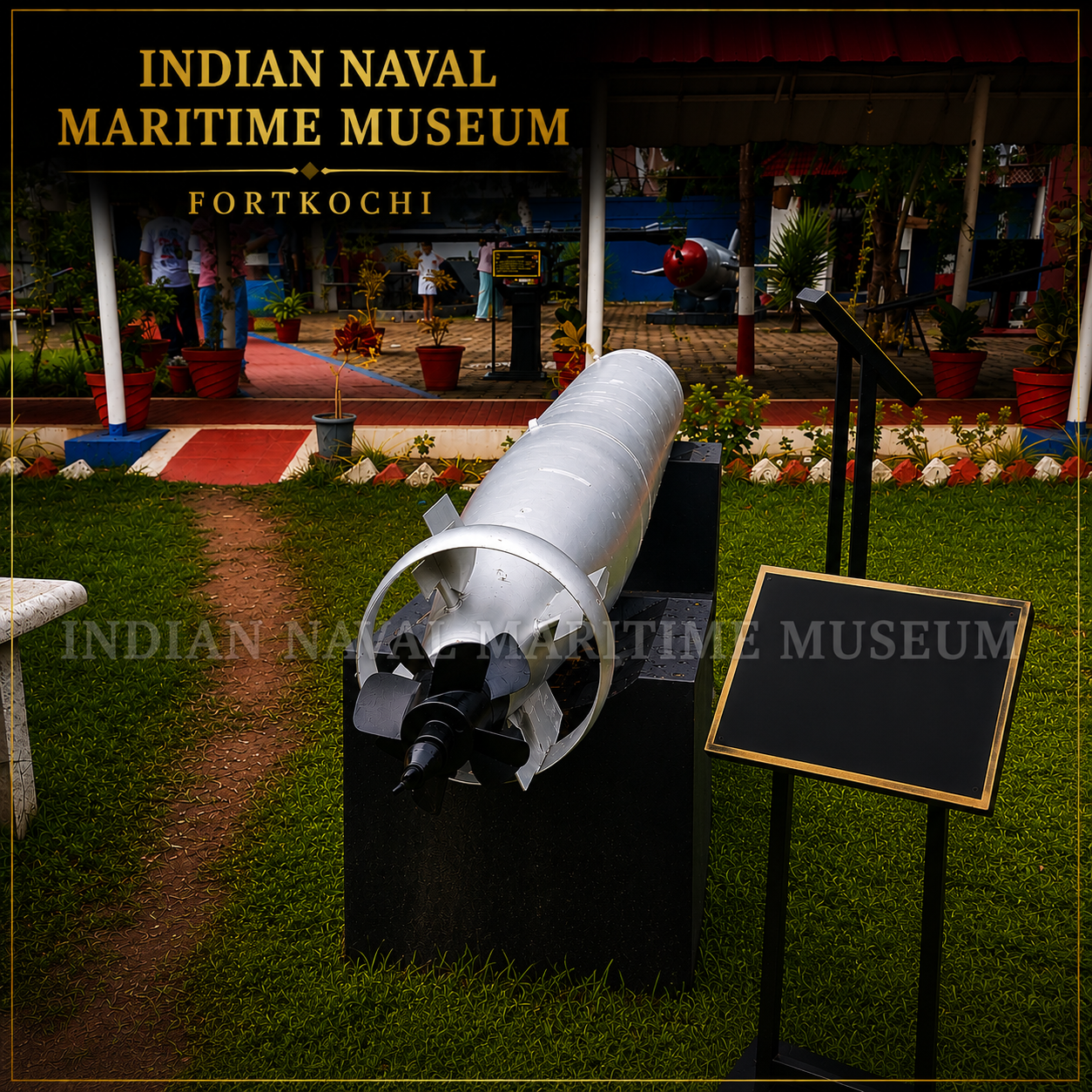
Mark 44 Torpedo
Audio Guide
Listen to artifact story
Audio guide ready
The exhibit shown at the Indian Naval Maritime Museum is the Mark 44 (Mk 44) Torpedo, a lightweight anti-submarine torpedo developed during the Cold War. It was designed to detect, track, and destroy enemy submarines operating beneath the sea surface.
The Mk 44 became one of the first widely used homing torpedoes in Western navies and was later adopted by several allied countries. It could be launched from aircraft, helicopters, or naval vessels and would automatically search for its target using an acoustic guidance system.
Once launched into the water, the torpedo used onboard sensors to detect submarine noise and home in on the target. This made it a highly effective weapon against submerged enemy submarines.
Technical Specifications
Name: Mark 44 (Mk 44) Torpedo
Type: Lightweight Anti-Submarine Torpedo
Origin: United States
Length: Approximately 2.5 m
Diameter: 324 mm
Weight: Around 190 kg
Guidance: Acoustic Homing System
Propulsion: Electric Motor
Maximum Speed: About 30 knots
Range: Approximately 5–6 km
Warhead: High-Explosive Charge
Role and Importance
Designed specifically for anti-submarine warfare (ASW).
Launched from ships, aircraft, and helicopters.
Automatically tracks enemy submarines underwater.
Increased naval forces' ability to counter underwater threats.
Helped protect fleets, convoys, and strategic maritime areas.
Historical Significance
The Mk 44 entered service in the 1950s and became one of the most successful anti-submarine torpedoes of its era. It was widely deployed during the Cold War when submarines became a major threat to naval operations. The torpedo laid the foundation for more advanced anti-submarine weapons developed later.
Interesting Fact
Unlike missiles that travel through the air, a torpedo is designed to operate entirely underwater. The Mk 44 could "listen" for submarine sounds and automatically steer itself toward the target, making it one of the earliest practical underwater guided weapons.
Museum Note
The Mk 44 Torpedo displayed at the Indian Naval Maritime Museum, Fort Kochi, represents an important milestone in naval anti-submarine warfare technology and highlights the evolution of underwater weapons used by modern navies.
The Mk 44 became one of the first widely used homing torpedoes in Western navies and was later adopted by several allied countries. It could be launched from aircraft, helicopters, or naval vessels and would automatically search for its target using an acoustic guidance system.
Once launched into the water, the torpedo used onboard sensors to detect submarine noise and home in on the target. This made it a highly effective weapon against submerged enemy submarines.
Technical Specifications
Name: Mark 44 (Mk 44) Torpedo
Type: Lightweight Anti-Submarine Torpedo
Origin: United States
Length: Approximately 2.5 m
Diameter: 324 mm
Weight: Around 190 kg
Guidance: Acoustic Homing System
Propulsion: Electric Motor
Maximum Speed: About 30 knots
Range: Approximately 5–6 km
Warhead: High-Explosive Charge
Role and Importance
Designed specifically for anti-submarine warfare (ASW).
Launched from ships, aircraft, and helicopters.
Automatically tracks enemy submarines underwater.
Increased naval forces' ability to counter underwater threats.
Helped protect fleets, convoys, and strategic maritime areas.
Historical Significance
The Mk 44 entered service in the 1950s and became one of the most successful anti-submarine torpedoes of its era. It was widely deployed during the Cold War when submarines became a major threat to naval operations. The torpedo laid the foundation for more advanced anti-submarine weapons developed later.
Interesting Fact
Unlike missiles that travel through the air, a torpedo is designed to operate entirely underwater. The Mk 44 could "listen" for submarine sounds and automatically steer itself toward the target, making it one of the earliest practical underwater guided weapons.
Museum Note
The Mk 44 Torpedo displayed at the Indian Naval Maritime Museum, Fort Kochi, represents an important milestone in naval anti-submarine warfare technology and highlights the evolution of underwater weapons used by modern navies.